
From a Broken Link to a Clearer Direction
It started with a broken link.
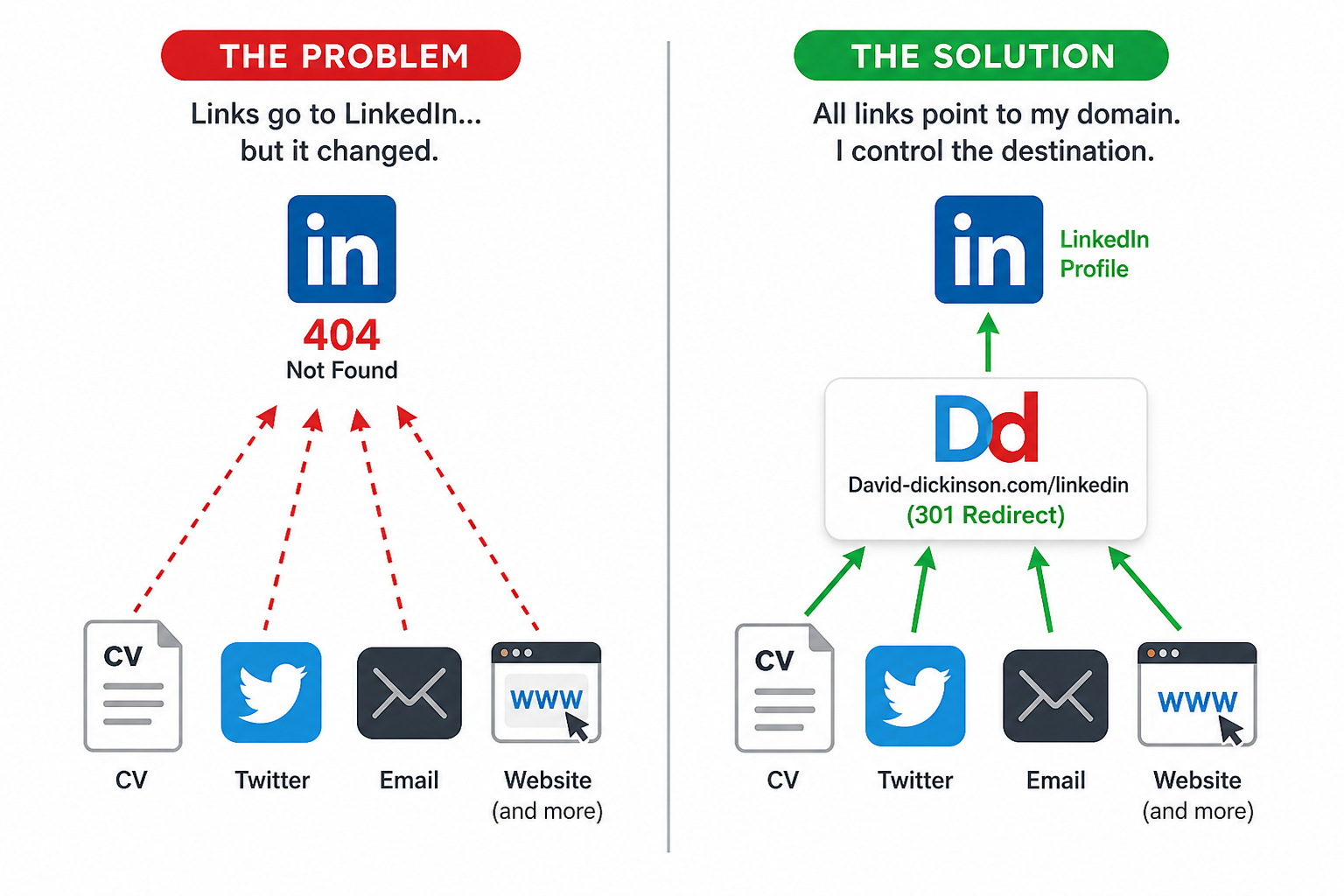
I noticed a few of my sites had links to my LinkedIn profile — in footers, about pages, the usual places — and some of them just didn’t work anymore.
At some point, my LinkedIn URL had changed.
Not dramatically, just enough:
- from something like
/david-dickinson-… - to
/david-d-…
But enough that the old links had quietly died.
I’d checked them when I first added them, but like most things on the internet, I never checked again.
Owning the link
Rather than fixing each one individually, I did something simple.
I stopped linking to LinkedIn directly.
Instead, I created:
/linkedin→ my LinkedIn profile/github→ my GitHub/twitter→ etc
All routed through my own domain.
So now, everywhere I link to LinkedIn, I actually link to:
david-dickinson.com/linkedin
If LinkedIn changes again (and it probably will), I update one place.
That’s it.
That small change led to something bigger
Once I’d done that, it made me look at everything else a bit differently.
If my links were scattered and fragile, what about everything else?
- multiple Twitter accounts
- a couple of YouTube channels
- a blog
- GitHub
All slightly different versions of me, depending on context.
None of it was wrong, but it wasn’t especially clear either.
So I started to simplify.
- My personal site became the hub
- Everything else became an extension of it
- Links stopped pointing everywhere, and started pointing through it
Looking at GitHub differently
That led me to GitHub.
Previously, I’d treated it a bit like a portfolio — a place to show what I’d built, prove I could code, and point people at projects.
But that didn’t really reflect how I work now.
So instead of trying to make it a “perfect” portfolio, I reframed it.
- My site → the place to understand me
- GitHub → the place to see how I build
I simplified the profile, pointed everything back to my site, and treated GitHub as part of a wider system rather than a standalone destination.
Then I looked at LinkedIn properly
That’s where it got more interesting.
I’ve been working in IT for a little over 20 years.
Network engineering, project management, infrastructure, security, some development along the way.
LinkedIn had faithfully collected all of that into a long list of skills.
And looking at it, I realised:
it didn’t tell a story — it just recorded everything I’d ever done
Which is accurate, but not very useful.
Direction vs history
The problem wasn’t that the skills were wrong.
It’s that they were unordered.
Equal weight was given to:
- things I did years ago
- things I still do
- things I’m starting to move towards
So I didn’t delete everything.
I just asked a different question:
what do I want this profile to point towards?
For me, that’s increasingly:
- Linux
- systems
- infrastructure
- building and experimenting
Something closer to SRE / systems engineering than where I started.
Tidying up without rewriting history
So I:
- surfaced the skills that align with that direction
- pushed older or less relevant ones down
- added a few that reflect where I’m going, not just where I’ve been
The underlying experience hasn’t changed.
Just the way it’s presented.
What this was really about
This started as fixing a broken link.
But it ended up being about something else:
control and clarity
- owning my own entry points (my domain)
- making it easier to understand what I’m doing
- aligning things with where I want to go next
Nothing dramatic.
Just a bit less noise, and a bit more direction.
If you’re curious
If you want to see how this all fits together now:
- https://david-dickinson.com
- https://david-dickinson.com/linkedin
- https://david-dickinson.com/youtube
- https://david-dickinson.com/twitter
Small practical takeaway
If you link to external platforms a lot, it’s worth routing them through your own domain.
Not for SEO or branding — just so you don’t have to fix them everywhere when they inevitably change.