
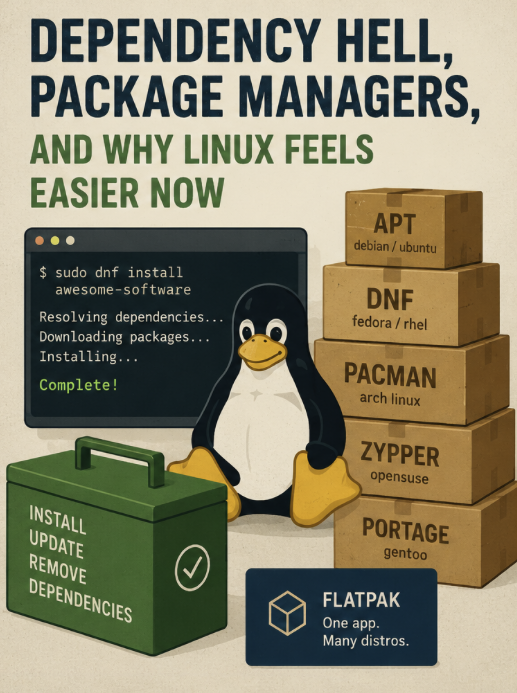
Dependency Hell, Package Managers, and Why Linux Feels Easier Now
I recently wrote a post revisiting my time with Fedora Core 3 and one of the things I had completely forgotten about from my early Fedora Core 3 experiments was just how much time I spent fighting package managers. Or more accurately:
fighting the things package managers were trying and occasionally failing to protect me from.
At the time, I did not really understand what package management was. I just knew that:
- installing software was harder than I expected
- dependencies kept breaking
- and every successful installation felt slightly accidental
This was especially noticeable when I started trying to make Linux feel like a usable desktop operating system rather than an interesting technical experiment.
- Playing MP3s.
- Installing Java.
- Getting wireless networking to work.
- Installing Apache.
- Trying random desktop applications from forum posts.
None of these tasks were impossible. None of them were particularly smooth either.
So… what actually is a package manager?
At a very basic level, package managers are tools responsible for:
- installing software
- updating software
- removing software
- and keeping track of what depends on what
That last bit is the important part. Because software rarely exists in isolation. One application may rely on:
- specific libraries
- runtime environments
- system utilities
- codecs
- kernel modules
- or other packages entirely
Without package management, Linux systems would collapse into complete chaos remarkably quickly. In practice, modern package managers let you do something like:
sudo apt install nginx
or:
sudo dnf install nginx
And behind the scenes the system:
- downloads the package
- resolves dependencies
- installs everything in the correct location
- updates package databases
- and makes sure the software can be updated cleanly later
When it works, it feels wonderfully simple. The important phrase there being:
when it works.
Dependency hell was a real place
Back during my Fedora Core 2 and 3 adventures, package management still felt slightly fragile. Fedora used:
yumup2date- RPM packages
And whilst these tools were already hugely better than manually compiling absolutely everything yourself, they could still occasionally descend into what people lovingly referred to as:
dependency hell.
Which was exactly what it sounded like. I remember trying to install software and getting trapped in loops where:
- package X required Y
- Y required Z
- Z conflicted with A
- A required an older version of X
- and suddenly nothing on the machine seemed emotionally stable anymore
At one point I became so annoyed with Fedora’s tooling that I wrote an article about installing Synaptic, mostly because I wanted something that behaved more predictably than up2date.
Looking back, I think I was slowly discovering that package management is one of those invisible layers that only becomes interesting when it breaks. Which is true of most infrastructure.
Different distros, different philosophies
One thing that confuses people coming to Linux is the sheer number of package managers. A few common examples:
| Distribution Family | Package Manager |
|---|---|
| Debian / Ubuntu | APT |
| Fedora / Red Hat | DNF (formerly YUM) |
| Arch Linux | Pacman |
| openSUSE | Zypper |
| Gentoo | Portage |
They all solve broadly the same problem:
keeping software installed and updated cleanly.
But they differ in:
- package formats
- repository structures
- dependency handling
- speed
- philosophy
- and occasionally how much suffering they expect from the user
Gentoo, for example, traditionally compiles software from source. Which is brilliant if:
- you enjoy optimisation
- have very specific requirements
- or consider “waiting for compilers” a recreational activity
Arch tends to lean toward minimalism and user control. Fedora historically moved quickly and aggressively with newer technologies. Ubuntu focused heavily on accessibility and ease of use. Over time, I realised Linux distributions are often less about technical superiority and more about:
different trade-offs for different audiences.
The thing modern Linux users may not realise
Linux package management today is dramatically better than it used to be. Modern Fedora with dnf feels substantially more reliable than early Fedora Core did. Ubuntu’s APT ecosystem is incredibly mature Dependency resolution is usually excellent. And crucially:
internet bandwidth stopped being part of the problem.
Back in the FC3 era:
- downloading repositories was slow
- mirrors frequently vanished
- metadata failed regularly
- and package conflicts were more common
I still remember tutorials telling you to manually hunt down RPMs from random websites because the repositories either:
- did not contain the software
- had outdated versions
- or were temporarily unavailable
This was considered normal.
Then came Flatpak, Snap, and containerised applications
Eventually Linux distributions started hitting another problem:
every distribution packaged software differently.
Which meant developers either:
- built packages for multiple systems
- or ignored some distributions entirely
This is where things like:
- Flatpak
- Snap
- AppImage
began appearing. The idea was fairly straightforward:
- bundle applications with their dependencies
- isolate them from the underlying system
- make them portable between distributions
In theory:
- fewer dependency problems
- easier installs
- more consistent environments
In practice:
- larger downloads
- duplicated libraries
- slightly awkward sandboxing
- multiple competing ecosystems
- and, because this is Linux, strong opinions everywhere
Ubuntu leaned heavily into Snap. Flatpak became popular elsewhere. Some people hated both immediately on principle. Which is also a very Linux outcome.
What I actually use now
These days, I mostly try to avoid making package management more complicated than it needs to be. Generally:
- use the distro package manager first
- use Flatpak rarely, but if portability or newer versions matter
- avoid mixing ecosystems unnecessarily
- and resist the temptation to install random packages from questionable repositories unless I absolutely need to
This sounds obvious. It was not obvious to me in 2005. In 2005 I would absolutely install something from:
- a forum post
- a partially translated website
- a SourceForge page
- or a tarball maintained by one person somewhere on the internet
and then act surprised when things became unstable afterwards.
Looking back now
The funny thing about revisiting these old LinuxJourney posts is realising how many infrastructure concepts I was accidentally learning while trying to do very ordinary things. I started wanting:
- MP3 playback
- wireless networking
- Java in Firefox
- and a working desktop environment
What I actually learned was:
- dependency management
- repositories
- software distribution
- system integration
- compatibility problems
- release management
- versioning
- and why ecosystems matter
At the time it mostly felt frustrating. In hindsight, it was probably one of the better technical educations I could have accidentally stumbled into.